DGX Spark + Ryzen 395 — homelab AI hardware reached its inflection in April
A user posted a 16x DGX Spark cluster with 2TB unified memory. AMD shipped a 128GB Ryzen 395 mini-PC. Homelab AI hardware moved from "expensive" to "credible" this month.
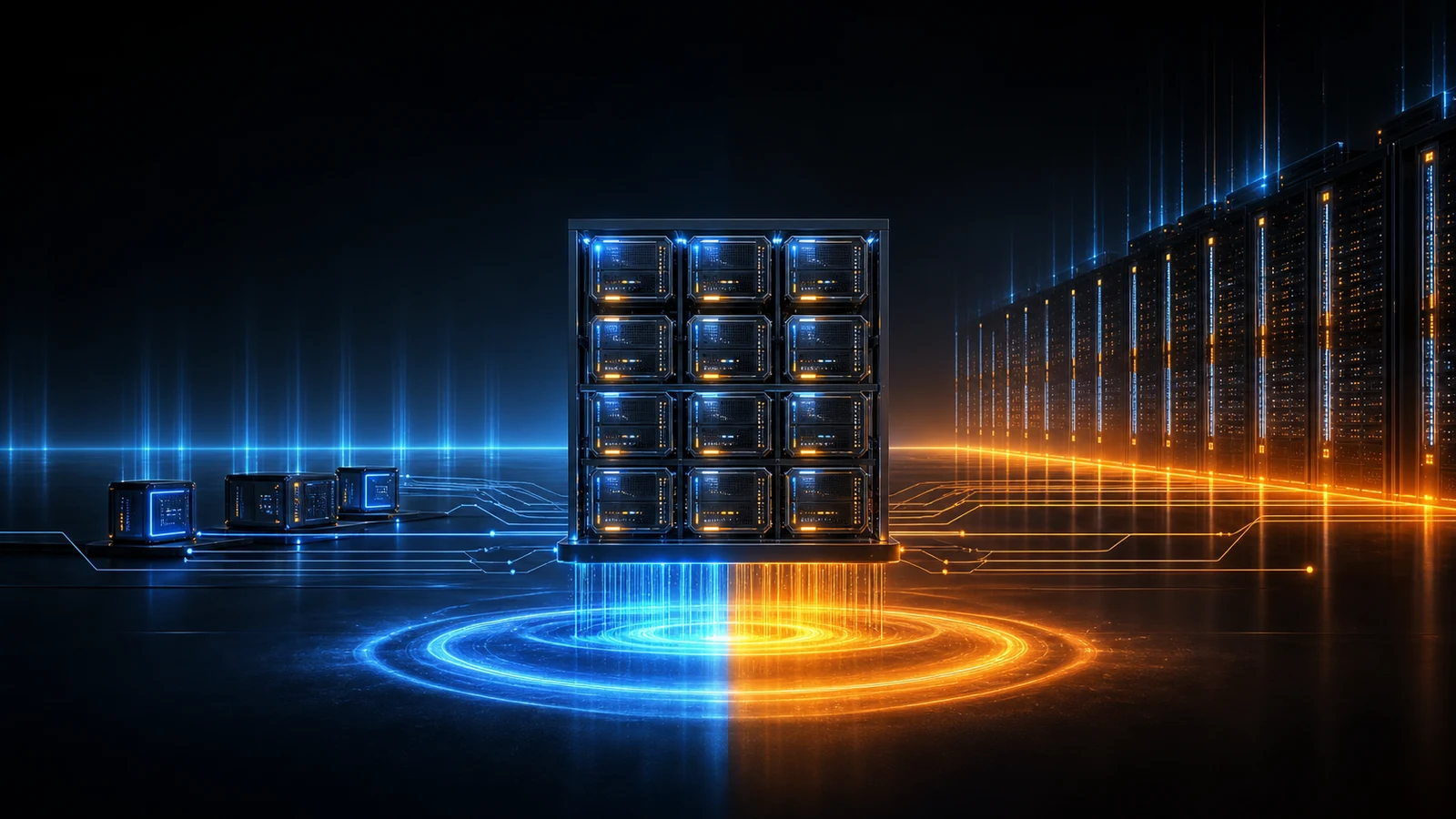
Two posts on r/LocalLLaMA in late April 2026 capture a substantive hardware shift. The first (1,597 upvotes) is a user with a 16-node DGX Spark cluster, 2TB of unified memory, 200Gbps QSFP56 fabric, all sitting in a home rack. The second (946 upvotes) covers AMD announcing a Ryzen 395 mini-PC with 128GB unified memory at AMD AI Dev Day, shipping in June.
These two posts, days apart, are bookends of the same story: April 2026 is when homelab AI hardware crossed from “expensive enthusiast” to “credible alternative to renting GPU time.” The high end is now serious (16x Sparks = a small lab). The low end is now accessible (128GB unified memory in a mini-PC at consumer pricing).
Christian Lempa’s April 30 video on Proxmox Ceph clustering — published the same day — frames the homelab infrastructure question more broadly: what does it take to run real workloads at home, professionally?
What changed at the top of the curve
The 16x DGX Spark cluster is unusual but instructive. From the OP’s specs:
- 16x DGX Spark nodes — NVIDIA’s small-form-factor inference appliance with Grace-Blackwell architecture
- 2TB total unified memory across the cluster
- 1x 200Gbps FS 24x QSFP56 switch as fabric
- 16x QSFP56 DAC cables for interconnect
Comment from a knowledgeable responder (466 upvotes):
“Kimi K2.6 runs very well on my eight node cluster with vLLM using eugr’s nightly builds. There are unmerged PRs for Deepseek V4 for vLLM. Flash runs fine on 8x, Pro could fit on your 16.”
This is not theoretical. People are running 400B+ parameter models on home clusters today. The hardware envelope for “what can be served on-prem” now includes the actual flagship open-weight models (Kimi K2.6, Deepseek V4, Qwen-class), not just smaller distillations. A year ago this required a colocated rack and serious capital. In April 2026, it’s a home rack, ~$50-80k, and a real electric bill.
That’s expensive — but it’s not “datacenter expensive.” For agencies, small AI startups, research labs, or well-funded individual operators, it’s now in range.
What changed at the bottom of the curve
The AMD Ryzen 395 mini-PC is the more important development. From the announcement:
- 128GB unified memory addressable by both CPU and integrated GPU
- Mini-PC form factor — wall-mountable, fanless or quiet
- No NVIDIA tax — AMD’s own silicon, AMD’s own pricing
- June 2026 ship at consumer pricing (rumored sub-$2000)
Top community read (220 upvotes):
“Is it supposed to be different from the other 395 mini pcs?”
Skepticism is fair — Strix Halo systems from other vendors have existed for months. The AMD-direct version’s significance is the implicit commitment: AMD is treating local-inference workstation hardware as a product line, not a niche. ROCm support, software stack maturity, and the GPU/NPU programming model are downstream consequences of that commitment.
For homelab users, the practical impact is: a single device that can run a 70B-parameter model at usable speeds without dedicated GPU buying is now consumer-priced. That’s a different inflection than “you can build a Threadripper rig with 4x 3090s if you really want to.”
The Apple Silicon parallel
The April-coverage M5 Max stack is the third leg of this story. Apple shipped 128GB unified memory in a laptop in 2025; the M5 Max generation pushed that further. Apple’s MLX framework is increasingly the reference for “actually-shipping local LLM tooling” on consumer hardware.
What April 2026 made clear: the unified-memory architecture is now the dominant pattern for local inference, across NVIDIA (Grace-Blackwell), AMD (Strix Halo / Ryzen 395), and Apple (M-series). Discrete GPUs with their own VRAM are still the highest-throughput option, but unified memory is what makes the 70B-100B model size fit on consumer-class hardware.
Creator POV vs Reddit dissent
The creator landscape is bullish-but-honest about local hardware:
- Lempa’s framing is operational — homelab clusters need real engineering (Ceph for storage, Proxmox for orchestration), not just a single big box. His Proxmox Ceph series is the canonical “homelab serious” content of 2026.
- bycloud’s framing is architectural — efficiency tricks (TurboQuant, 2x-faster inference) make the hardware go further; the curve is bending faster than hardware alone.
The Reddit dissent is more pointed than the creator dissent. From the DGX Spark thread:
“You just called us poor in 16 ways.” — 113 upvotes
“Ken, please stack the DGX Sparks on the shelves. The store is opening in 15 minutes.” — 1,079 upvotes (the top-voted comment, mocking the OP)
Beneath the humor, the substance: even with hardware getting cheaper, 16x DGX Sparks is still elite-tier homelab. The democratization narrative (“you can do this at home now!”) is true at the 1-2 device scale and false at the 16-node-cluster scale. Conflating them is what makes the dissent sharp.
For the AMD Ryzen 395 box, the response is more even-handed — most users see it as a useful unlock without overhyping it. The right framing: a $2000 box that runs 70B models is a meaningful unlock for the next-tier homelab user.
What this means for working engineers
Three concrete positions in April 2026:
1. If you’re shopping for AI-capable hardware, wait two months. AMD’s June ship will reset the price/performance curve on consumer unified-memory boxes. NVIDIA will respond. Apple’s M6 generation is rumored. Don’t buy this week.
2. If you’re building a homelab cluster, treat it as a real infrastructure project. Proxmox + Ceph + GPU passthrough + monitoring + power management — these aren’t optional for cluster-tier setups. Lempa’s content covers this seriously; budget for the operational tax.
3. If you’re evaluating “should I move workloads home,” do the math properly. Hardware amortization + electricity + maintenance + opportunity cost on quality gap. For some workloads (privacy-sensitive, high-volume, rate-limit-bound) the math closes in April 2026. For others (frontier-quality dependent), it doesn’t.
The honest critique
What the homelab AI hardware narrative gets wrong:
- “Cheaper than the cloud” is workload-dependent. A 24/7 saturated workload pays off home hardware fast. A bursty 4-hour-per-week workload doesn’t. The amortization math is unforgiving on irregular usage patterns.
- The capability gap with frontier hosted models is still real. Even at 16x DGX Sparks, you’re running Kimi K2.6 / Deepseek V4 — strong, but not Opus 4.7 or GPT-5.5 on hard tasks. The “I have a small lab at home” cluster is competitive with hosted on most workloads, not all.
- Power and noise are real homelab constraints. A 16-node Spark cluster pulls real wattage. Most “homelabs” are actually a closet with a single rack. Plan for the constraints.
For most working engineers in April 2026: homelab AI hardware is now an interesting capital-allocation decision, not a “future-of-computing” speculation. Run the numbers on your workload, watch the June AMD ship, and treat the 2026 hardware wave as making the local-inference path increasingly defensible — without yet making it the only sensible path.
Sources
Every reference behind this piece. If we make a claim, it's because at least one of these said so — or we lived it ourselves.
- YouTube Christian Lempa — "Why You Need 3 Nodes // My Proxmox Ceph Cluster Project!" — Christian Lempa
- YouTube bycloud — "Google's TurboQuant Memory Reduction Claim vs Reality" — bycloud
- YouTube bycloud — "This Simple Trick Made ALL LLMs 2x Faster" — bycloud
- Docs NVIDIA DGX Spark and AMD Strix Halo (Ryzen 395) product pages — NVIDIA / AMD
- Blog r/LocalLLaMA — "16x DGX Sparks - What should I run?" (1597 upvotes) — r/LocalLLaMA
- Blog r/LocalLLaMA — "AMD in-house ryzen 395 box coming in June" (946 upvotes) — r/LocalLLaMA
- Firsthand Building local-inference homelab clusters with Apple Silicon, NVIDIA, and AMD substrates