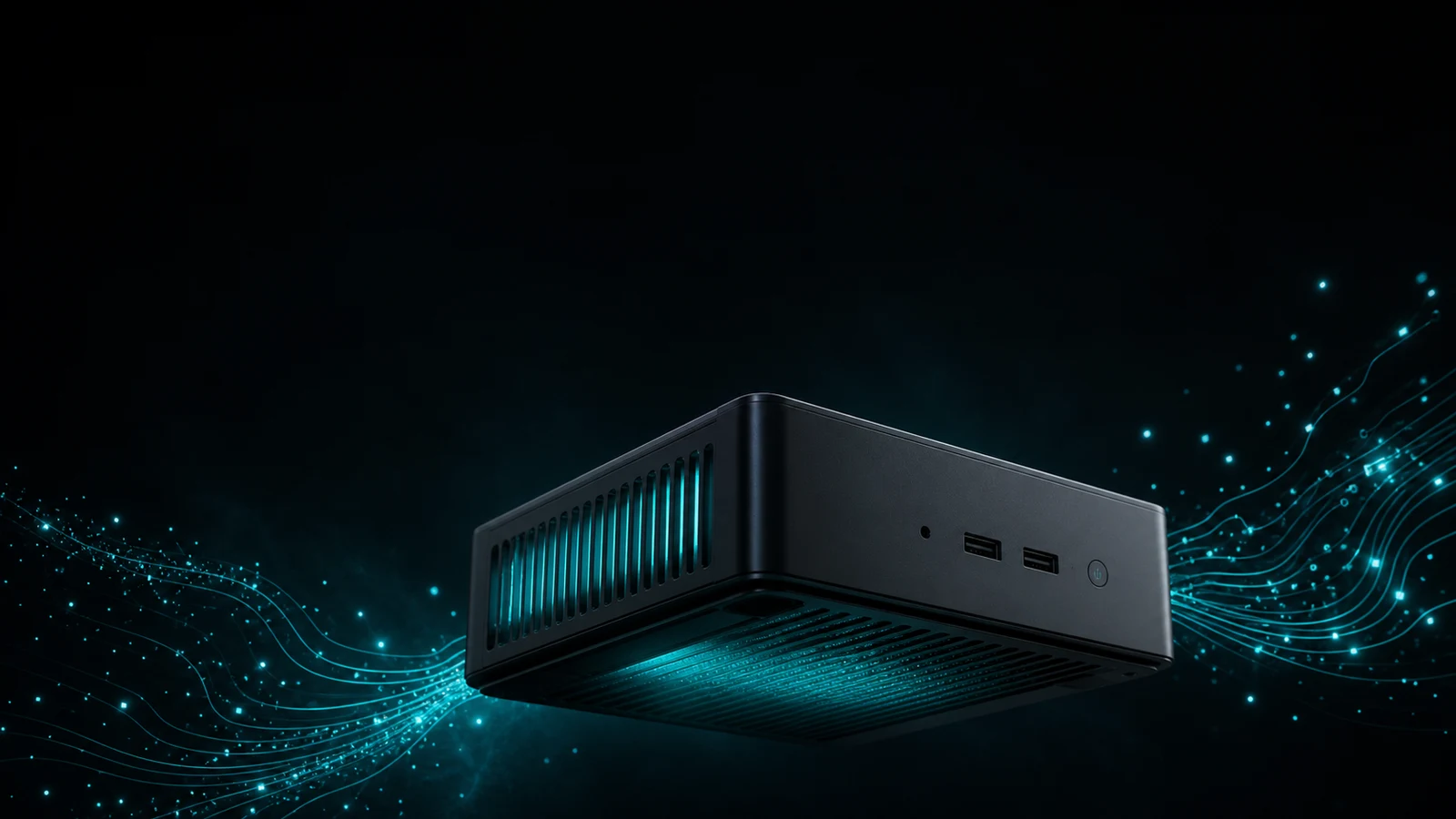
Minisforum MS-R1 review: the world's first ARM mini workstation, three months in
Minisforum MS-R1 shipped Nov 2025 as the first ARM mini workstation with real PCIe Gen4 x8 + dual 10GbE. Three months of reviewer testing — what the $504-$695 box delivers, and what it doesn't.
Jeff Geerling’s “Arm Homelab-in-a-Box” video and his companion blog post, both published shortly after the November 10, 2025 launch, framed the Minisforum MS-R1 the same way Minisforum’s own marketing does: the world’s first ARM mini workstation. That claim is technically defensible — a 1.7-litre chassis with a 12-core ARM SoC, dual 10GbE, and a real PCIe Gen4 x8 slot is genuinely a first. Whether that translates into a machine you should actually buy is a much more uncomfortable question, and the three months since launch have made the answer clearer rather than rosier.
Our verdict
Best for: ARM-curious homelabbers who want native aarch64 for CI/CD or container work, anyone who specifically needs dual 10GbE in a 1.7L chassis, and tinkerers willing to absorb early-adopter pain on a brand-new SoC.
Not for: Anyone optimising for performance-per-dollar, idle-power-sensitive 24/7 deployments, users who need mainline-kernel Linux today, or anyone who would otherwise buy a Mac mini or used N100 mini PC.
Why this box matters at all
ARM in the homelab has, until now, meant either a Raspberry Pi cluster (cheap, slow, painful networking) or an Apple Silicon Mac mini (fast, expensive, hostile to running as a headless server). The MS-R1 is the first attempt at a third path: workstation-class I/O — dual 10GbE, PCIe Gen4 x8 for a discrete GPU or HBA, U.2 storage — wrapped around a brand-new Chinese-designed ARM SoC, sold at mini-PC prices. If it worked cleanly, it would be the obvious base for an aarch64 CI runner farm, a low-power Ceph node, or an experimental dGPU-on-ARM rig. The question every reviewer ends up circling is whether “first” is the same thing as “good.”
Real specs — corrected
The launch coverage from VideoCardz, Tom’s Hardware, and the Minisforum product page line up on the numbers:
- SoC: CIX P1 (CP8180) — 12 cores (8× Cortex-A720 + 4× Cortex-A520), 2.6 GHz base, 28W TDP, Arm Immortalis-G720 MC10 GPU, 45 TOPS combined AI compute (28.8 TOPS NPU)
- Memory: 32GB or 64GB LPDDR5-5500, soldered — no upgrades, ECC supported at the cost of ~12.5% usable capacity
- Networking: dual 10GbE (Realtek RTL8127), WiFi 6E (MediaTek), Bluetooth 5.3
- Expansion: one PCIe Gen4 x16 physical / x8 electrical low-profile slot, two M.2 2280/22110 slots (one shared with WiFi-card carrier), U.2 adapter available
- Chassis: 1.7 litres, active cooling
- Price: $503.90 (32GB, no SSD) / $575.90 (32GB + 1TB) / $695.90 (64GB + 1TB) — all global, direct from Minisforum
It is, importantly, not a Snapdragon. It is not Ampere Altra. It is the CP8180 from CIX — the same SoC that ships in the Radxa Orion O6 dev board, and the first attempt by a Chinese fabless ARM-server vendor to land in a consumer chassis. That provenance matters for everything that follows.
Real-world performance
Geerling’s GitHub review issue is the single best source of measured numbers, because he runs the same benchmarks on every box he tests:
- Geekbench 6: 1336 single / 6773 multi
- HPL (Linpack): 143.03 Gflops at 39W → 3.67 Gflops/W
- Peak power under stress-ng: 30.3W
- iperf3 over the onboard 10GbE: 9.40 Gbps
- WiFi 6E throughput: 925 Mbps
Geekbench 1336 single-core puts the CP8180 in roughly the same neighbourhood as a Snapdragon 8cx Gen 3 or, as one Hacker News commenter on the Geerling thread put it more bluntly, a midrange Android phone from 2022. The 12-core multi-thread score of 6773 is respectable for the power envelope but well behind a current Apple M-series chip or even an Intel N100 in many workloads. ServeTheHome’s written review called the box “not yet ready” enough that they declined to produce video coverage at launch — the team had hit boot-stopping issues and pointed back to “such a bad experience” with the same SoC on the Radxa O6 that they had never finished that review either.
igor’sLAB’s Windows-on-ARM attempt is the most generous of the long-form reviews. They like the hardware — “well thought out and solidly implemented,” metal perforated top, decent radial cooling, sensible I/O — but the software story is exactly what you would expect for a new SoC: customised Debian 12 ships and boots, Windows 11 does not, the integrated Immortalis-G720 has no native Windows driver, and the firmware is “immature.” Their honest framing: a “clearly experimental product.”
Reviewer POV vs owner reality
This is where the picture sharpens. Geerling, Lempa, and igor are all doing time-boxed reviews. The owner who ran the MS-R1 for weeks as a Samba domain controller (sour.coffee, which hit the Hacker News front page with 126 points and 98 comments) catalogues the issues you only find after living with it:
- Rocky Linux didn’t detect the onboard Realtek RTL8127 NICs at install time. Sideloading the r8127 driver felt “hacky.” They switched to Fedora 43, which had upstream support.
- The M.2 slot situation is annoying: one of the two slots is occupied by the WiFi card, the second supports U.2 (via adapter) rather than a second M.2 NVMe — exactly the layout STH and Geerling both warn about.
- A Marvell AQC107 add-in NIC never got detected by the UEFI, despite being a standard part.
- The “power on after outage” BIOS option was non-functional until they discovered it required a physical switch on the board to be flipped — the kind of detail that does not appear in any product page or first-impressions video.
The Hacker News discussion under that review (and under Geerling’s post) converges on three points the YouTube reviewers either underplay or skip:
- Idle power is the real story, and it’s bad. 17W at idle, 18.1W with the 10GbE link up, is in the same range as a modern x86 mini PC — the entire efficiency premise of ARM in the homelab does not hold here. Geerling himself confirmed CIX is “working on power draw” and ASPM, and that the big-medium-little core layout currently requires the chip to stay powered up to keep inter-core memory access stable.
- The PCIe slot has no active cooling. Drop in a U.2 drive or a low-profile GPU and you are relying on chassis airflow that was not designed with the slot in mind.
- Minisforum’s reliability reputation is a real factor. Multiple commenters surface dead units and unstable BIOS releases across the MS-01 and MS-A1 generations. The MS-R1 is a brand-new SoC on a vendor that already has a “BIOS that needs three revisions” reputation.
Christian Lempa’s video treats the box more charitably than Geerling does — it is, after all, the first ARM mini workstation, and on a hardware-tour level it is impressive. But the long-form written reviews and the owner reports are uniformly more cautious than the video coverage, and the gap is exactly the kind of reviewer-vs-owner reconciliation TopInsight exists for. The video framing rewards “this is exciting and new.” The written framing rewards “here is what broke at week three.”
What this means for homelab builders in Q1 2026
A short version, for the homelabber deciding what to do with $500–$700:
- If you want a quiet 24/7 ARM compute node, the MS-R1 idle power eats the case for it. A used Lenovo Tiny with an N100 or a Mac mini M4 will give you better performance-per-watt and a software stack that already works.
- If you specifically need dual 10GbE in a tiny chassis, the MS-R1 is genuinely interesting — that combination basically did not exist before — but only if you are prepared to live with Realtek 10GbE and a not-yet-mainline kernel.
- If you are building an aarch64 CI runner farm or doing native ARM development for embedded / automotive / Android, the MS-R1 is the cheapest way to get a real workstation-class ARM box on your desk. That use case justifies the early-adopter tax.
- If you are buying it as “an ARM Mac mini that runs Linux,” stop. Buy the Mac mini, run Linux in a VM, accept the trade-offs. You will be happier.
The honest critique
Pulling the warts into one list, because the reviewers tend to scatter them:
- Idle power 14–17W, worse than modern x86 mini PCs and contrary to the whole ARM-efficiency pitch
- LPDDR5 is soldered — no RAM upgrades, ever, and the slower DDR5-5500 already kneecaps the SoC versus the Radxa Orion O6 with the same CP8180
- PCIe x8 slot has no dedicated cooling — anything you put in is thermally on its own
- U.2 install requires removing the WiFi card and using the adapter — fine if you planned for it, surprising if you didn’t
- USB implementation is buggy per STH’s hands-on
- Realtek RTL8127 onboard NIC needs driver workarounds on some distros (Rocky/RHEL family especially)
- Linux support is “in progress,” not mainline. You are running Minisforum’s customised Debian 12 with a vendor kernel
- Windows on ARM does not really work yet — no GPU driver, immature ACPI
- Minisforum’s track record on UEFI/BIOS stability is a real risk factor on a brand-new SoC
- CPU performance is roughly Snapdragon-8cx-Gen-3 / 2022-midrange-Android tier — fine for containers and CI, modest for anything CPU-bound
- It loses to its own sibling. The Radxa Orion O6 with faster RAM outperforms the MS-R1 on the same SoC
The verdict, soberly
The MS-R1 is the right machine for a narrow band of buyers and the wrong machine for almost everyone else. Geerling’s own one-liner — that this is a bad value where it stands today in the $500–$600 range, and unless you are specifically an ARM enthusiast you should buy something else — is the most honest summary in any of the coverage. The hardware is genuinely a first; the software and power story have to catch up before “first” turns into “recommended.”
The deeper story is that Chinese fabless ARM is now landing in consumer-priced workstation chassis at all. That is a meaningful Q1 2026 marker even when the specific product is uneven. Watch CIX’s next firmware revision, watch whether the kernel work lands upstream, and re-evaluate at the 90-day mark.
Reddit corpus is still sparse for this November 2025 launch — Google’s site:reddit.com indexing returned no substantive /r/MiniPCs or /r/homelab threads on the MS-R1 at the time of writing, which is why this review leans on Hacker News (the sour.coffee owner review and the Geerling post discussion) and the long-form written reviews from ServeTheHome, Geerling’s blog, and igor’sLAB instead. We will refresh this piece at the 90-day mark once Reddit discussion catches up.
For broader homelab context, see the UGREEN NAS DH4300 Plus review for the x86 small-NAS counterpoint, and the n8n homelab automation piece for the kind of container workload the MS-R1 actually handles well.
Sources
Every reference behind this piece. If we make a claim, it's because at least one of these said so — or we lived it ourselves.
- YouTube Jeff Geerling — "Arm Homelab-in-a-Box – Minisforum MS-R1" — Jeff Geerling
- YouTube Christian Lempa — "Minisforum MS-R1 Review: The World's First ARM Mini Workstation" — Christian Lempa
- YouTube Third-party MS-R1 hands-on coverage — YouTube (independent)
- Blog ServeTheHome — "The Minisforum MS-R1 12-core ARM 10GbE mini workstation is…" — ServeTheHome (Patrick Kennedy)
- Blog Jeff Geerling — "Minisforum stuffs an entire Arm homelab in the MS-R1" — Jeff Geerling
- Blog igor'sLAB — "Chinese ARM CPU meets Windows: Minisforum MS-R1 with CIX P1 CP8180" — igor'sLAB
- Blog sour.coffee — "An ARM Homelab Server, or a Minisforum MS-R1 Review" (HN: 126 points, 98 comments) — sour.coffee (owner long-term review)
- Blog Hacker News — discussion on the sour.coffee MS-R1 review — Hacker News
- Blog Hacker News — discussion on Jeff Geerling's MS-R1 post — Hacker News
- Docs Minisforum MS-R1 product page — Minisforum
- Docs VideoCardz launch coverage — pricing tiers and chassis details — VideoCardz
- Firsthand Cross-referencing four written reviews and two YouTube reviews against owner reports