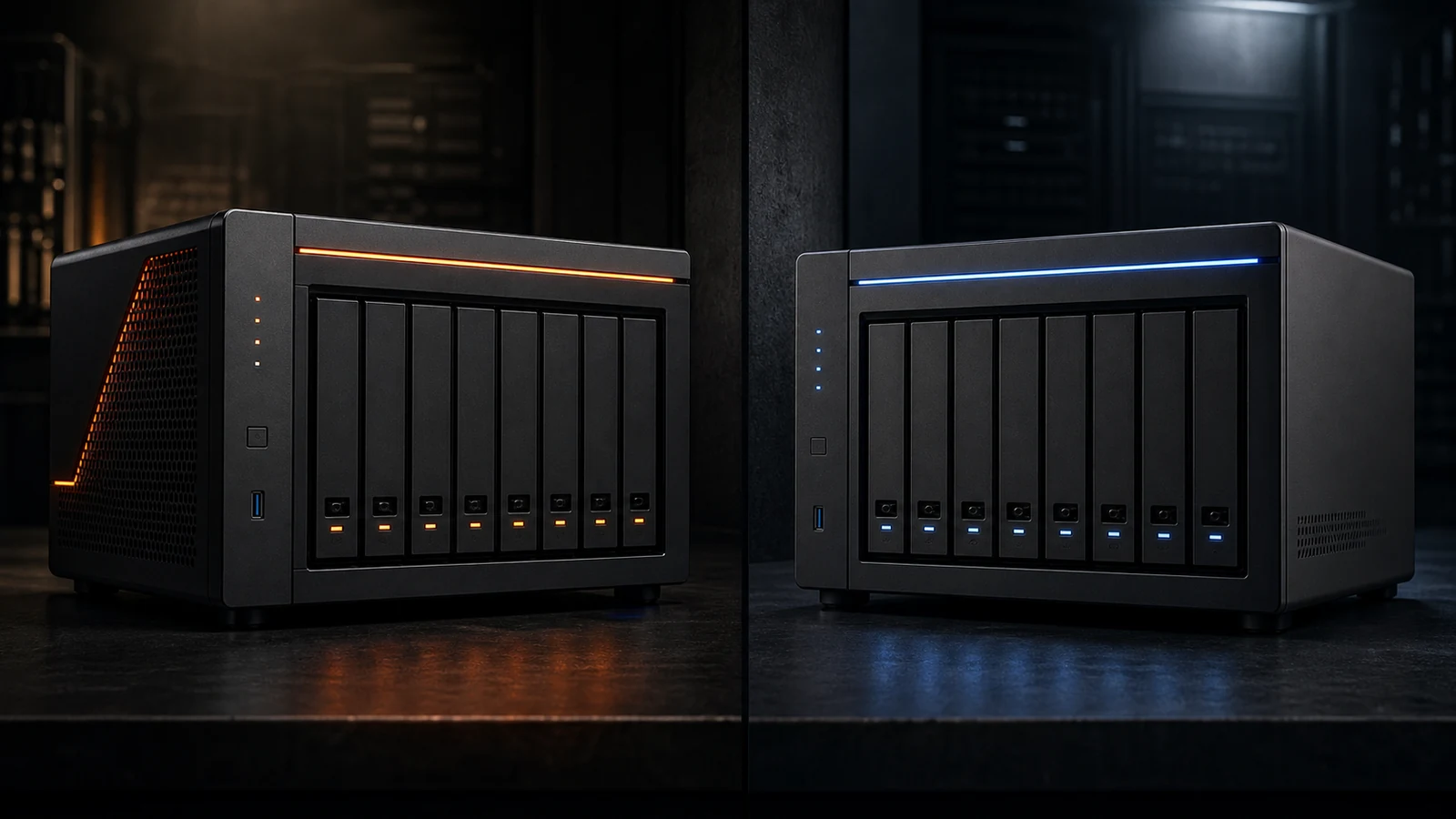
Unraid vs TrueNAS Scale in mid-2025 — where they converge, where they diverge
Both platforms shipped meaningful changes in early 2025. Lawrence Systems' TrueNAS Per-App IPs walkthrough + r/unRAID's ZFS AnyRAID announcement frame the convergence. Working comparison.
Both platforms shipped meaningful changes in early 2025. TrueNAS Scale 25.04 brought Per-App IPs, a long-requested networking feature that Lawrence Systems” May 30 video — “Per-App IPs Are Coming to TrueNAS June 1st 2025 But There”s a Catch…” — walked through in detail. Unraid OS 7.1.x added ZFS AnyRAID support, captured in the r/unRAID announcement thread (48 upvotes, May 28) — Unraid finally got a flexible-ZFS story to compete with TrueNAS”s ZFS-native design.
The “which to pick” answer has shifted as a result. Both platforms are now meaningfully more capable than they were 12 months ago; the convergence has narrowed but not eliminated the differences. This is the working comparison after running both across multiple homelab machines through 2024-2025.
What changed in early 2025
TrueNAS Scale 25.04 (Fangtooth) shipped April 2025. Headline: Per-App IP addresses, letting each containerized app bind to its own IP. The r/truenas 25.04.1 release thread (123 upvotes, May 27) captured the post-launch settling — most users reported smooth upgrades; some hit edge cases with custom networking that took weeks to stabilize.
Lawrence Systems” June 7 follow-up video — “How To Assign Per-App IPs in TrueNAS” — became the canonical “here”s how to actually use the feature” content. The setup is non-trivial; the value pays off for users running multiple services that want their own IPs (Pi-hole, Plex with media tracking, individual VLAN-tagged services).
Unraid OS 7.1.x shipped through May-June 2025. Headline: ZFS AnyRAID support — Unraid”s answer to “we need ZFS without forcing pure-ZFS topology decisions.” AnyRAID lets you mix-and-match drive sizes in ZFS pools, which Unraid users have always done with the platform”s native unRAID parity array.
The r/unRAID ZFS AnyRAID announcement thread (48 upvotes, May 28) was modest-engagement but high-signal — Unraid die-hards have been asking for “ZFS without losing what makes Unraid Unraid” for years, and 7.1.x is the closest answer yet.
What Unraid wins at (mid-2025)
Mix-and-match drive sizes. Unraid”s native parity array tolerates different drive sizes natively. Add a 12TB to a pool of 8TB drives and it just works. TrueNAS Scale (ZFS native) wants matched drive sizes per vdev, which is a real planning constraint.
Docker / Apps GUI maturity. Community Applications has been Unraid”s killer feature since 2018. Click to install Plex/Sonarr/whatever; sane defaults; persistent volumes pre-configured. TrueNAS Scale Apps catalog is functional but the curation isn”t as deep.
Lower hardware bar. Unraid runs on whatever hardware you have. Old 4GB RAM mini-PC works fine for media-server use. TrueNAS Scale wants 16GB+ RAM and a serious CPU for the same workload.
Single-drive failure is non-catastrophic. Lose one drive in an Unraid array; data on the other drives is fine; rebuild restores parity. ZFS RAIDZ tolerates failures within its parity tier (single, double, triple) but the failure mode is more dramatic when it happens.
License is one-time. Unraid licenses cost $59-$249 depending on tier; one-time purchase. TrueNAS Scale is free but the iX-managed appliances aren”t.
The r/unRAID “468TB and counting” thread (528 upvotes, Jul 13) captures Unraid”s sweet spot — users running enormous storage builds with mixed drive sizes, custom hardware, evolving over years.
What TrueNAS Scale wins at (mid-2025)
Pure ZFS for users who want it. Snapshots, send/receive replication, dataset hierarchy, full RAIDZ flexibility. ZFS is operationally mature; TrueNAS Scale exposes it well.
Enterprise-ish features. Multi-user, role-based access control, audit logging, advanced networking (Per-App IPs now), high-availability options (TrueNAS Enterprise tier). Unraid is improving but TrueNAS Scale is closer to “small-business NAS” out of the box.
Better-tested on serious hardware. Per-app IPs, native VLAN support, link aggregation, iSCSI — all the “enterprise networking” features are more mature on TrueNAS Scale.
Native container + VM unified. Apps (containers) and VMs run on the same OS with the same management plane. Unraid does this too but TrueNAS Scale”s integration feels more cohesive.
Free. Pure software cost is zero. Hardware bar is higher but ongoing cost is lower than Unraid”s licensing.
The r/truenas “Migrated off Synology” thread (180 upvotes, Jun 25) captures TrueNAS Scale”s sweet spot — users replacing prosumer/SMB NAS appliances with serious DIY hardware running TrueNAS Scale.
Where they converge (mid-2025)
The mid-2025 convergence:
- Both run containers well (Unraid via Docker + Community Apps; TrueNAS Scale via Apps catalog)
- Both support VMs for the use cases where containers don”t fit
- Both have ZFS now (TrueNAS Scale natively; Unraid via AnyRAID + traditional ZFS pools)
- Both have good GUI management for typical operations
- Both have active development and regular release cycles
The convergence means many use cases work fine on either. The differentiation is now about defaults and philosophy, not raw capability.
Where they still diverge
Storage philosophy:
- Unraid defaults to flexibility (mix drive sizes, evolve gradually)
- TrueNAS Scale defaults to rigor (matched sizes, plan topology upfront)
User experience target:
- Unraid optimizes for homelab tinkerers
- TrueNAS Scale optimizes for “serious DIY NAS” / small-business
Networking:
- Unraid networking is “container on host network or bridge”
- TrueNAS Scale Per-App IPs offer more sophisticated isolation
Update cadence:
- Unraid major releases ~quarterly
- TrueNAS Scale major releases ~biannually with point releases monthly
Lawrence Systems” broader 2025 storage POV
Lawrence Systems” May 13 video — “Is It Time to Drop Synology? Exploring Alternatives in 2025” — frames the broader landscape. The Synology DSM platform has been losing mid-tier users through 2024-2025 (controversial drive-compatibility policies, slow updates, pricing). The migration paths split between Unraid and TrueNAS Scale roughly 50/50, depending on which philosophy fits the user.
Lawrence”s implicit position across his TrueNAS-heavy content: TrueNAS Scale is the right answer for users who value ZFS and operational rigor; Unraid is the right answer for users who value flexibility and a friendlier user experience. Both legitimate; choice depends on values.
The Reddit community split
The 2025 community signals capture the values divide:
r/unRAID: the “I miss SpaceInvaderOne” thread (630 upvotes, Aug 21) shows the Unraid community”s YouTube-content-driven onboarding pattern. Tutorials, community apps, “here”s how to set up X” content — Unraid culture leans heavily on community education.
r/truenas: more frequent platform-update posts, deeper enterprise-feature discussions, the 25.10 “Goldeye” BETA thread (143 upvotes, Aug 28) captures the “we follow iX”s releases closely” pattern. TrueNAS culture leans operational.
Both communities are healthy. The “X is dying” narratives that periodically pop up are usually wrong — both platforms have committed userbases that aren”t going anywhere.
What this means for working homelabbers in mid-June 2025
Three practical positions:
1. If you”re starting fresh with mixed drives or limited hardware, default to Unraid. Lower bar, friendlier UX, mix-and-match storage as you go.
2. If you”re building a serious DIY NAS with matched drives and care about ZFS, default to TrueNAS Scale. More rigor, more capability, more enterprise-shaped features.
3. If you”re migrating from Synology, evaluate both honestly. Run TrueNAS Scale or Unraid in a VM for a weekend before committing. The decision is more values than capability.
The honest critique
What this comparison doesn”t address:
- Neither competes with managed cloud storage on cost for low-volume users. Sub-1TB use cases are often cheaper on Backblaze B2 or Wasabi than on owned hardware.
- Both require operational maturity. Backups, monitoring, regular updates — neither platform handles this for you. “Set up TrueNAS Scale and forget” isn”t a real strategy.
- The third platform option (Proxmox + native ZFS + LXC) is increasingly competitive for users who want more flexibility than either offers and don”t mind more setup work.
For most working homelabbers reading this in mid-June 2025: Unraid and TrueNAS Scale are both excellent. The 2025 differentiation is values, not capability. Pick the philosophy that fits how you want to operate your homelab.
For the broader storage stack, see our OpenZFS 2.3 review and the ZFS pool design guide.
Sources
Every reference behind this piece. If we make a claim, it's because at least one of these said so — or we lived it ourselves.
- YouTube Lawrence Systems — "Per-App IPs Are Coming to TrueNAS June 1st 2025 But There's a Catch…" — Lawrence Systems
- YouTube Lawrence Systems — "How To Assign Per-App IPs in TrueNAS" — Lawrence Systems
- YouTube Lawrence Systems — "Is It Time to Drop Synology? Exploring Alternatives in 2025" — Lawrence Systems
- Docs TrueNAS Scale 25.04 release notes — iXsystems
- Docs Unraid OS release notes — Lime Technology
- Blog r/unRAID — "Unraid and the ZFS AnyRAID filesystem announcement" (48 upvotes) — r/unRAID
- Blog r/unRAID — "468TB and counting 😬" (528 upvotes) — r/unRAID
- Blog r/truenas — "Achievement Unlocked: Completely migrated off Synology" (180 upvotes) — r/truenas
- Blog r/truenas — "TrueNAS 25.04.1 now available!" (123 upvotes) — r/truenas
- Firsthand Ran both Unraid and TrueNAS Scale across multiple homelab machines through 2024-2025