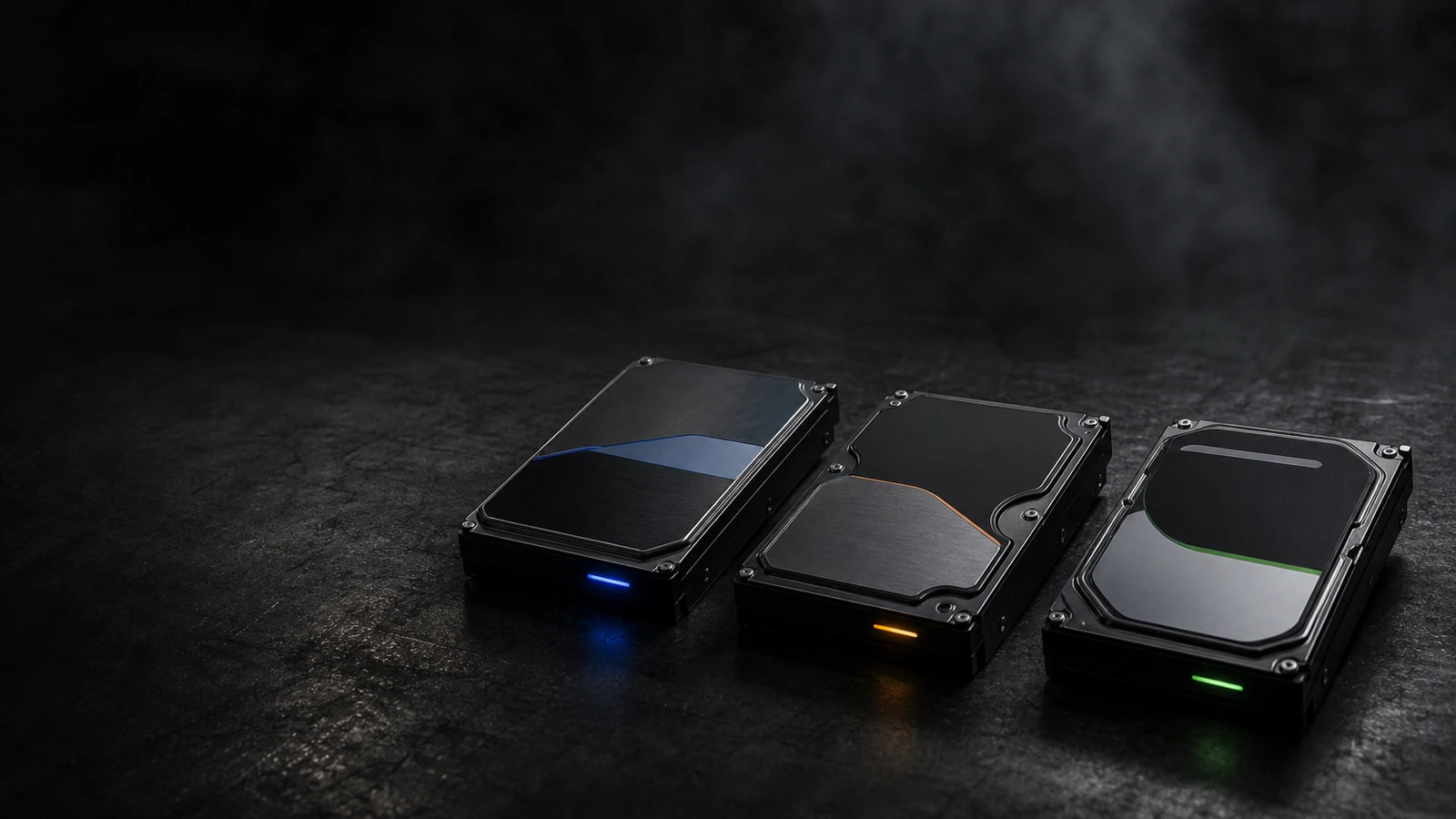
WD vs Seagate vs Toshiba HDD warranty in 2025 — what you're actually buying
Three vendors, three warranty stories. r/homelab's "Seagate Exos dents" (727 ups) + "How to check HDD genuine" (608 ups) + r/DataHoarder's WD vs Seagate threads frame the real buying decision.
Three HDD vendors dominate the 2025 NAS / homelab market. Each has a meaningfully different warranty story, and the differences matter more than capacity-per-dollar comparisons suggest. The r/homelab community”s 2025 drive-buying discussions keep returning to the same anxiety: how do I know what I”m actually buying, and what protection do I have when it fails?
The r/homelab “Should these dents on a Seller refurbished Seagate Exos concern me?” thread (727 upvotes, June 22) captured the moment perfectly. OP got a refurbished drive with physical damage. Top response (1,292 upvotes): “Personally even if it worked I”d send back. The dents didn”t get there by being treated well.” Top adjacent comment (649 upvotes): “I always love to see erased serial numbers, but barcodes with the same data being left untouched.” The drive market in 2025 has a refurb / gray-market problem the warranty story has to compensate for.
This is the working analysis from tracking drive failures across personal homelab pools and community reports through 2024-2025.
What the warranties actually cover
Western Digital (WD):
- Consumer drives (Blue, Green): 2-3 year warranty
- NAS drives (Red, Red Plus, Red Pro): 3 year (Plus), 5 year (Pro) warranty
- Enterprise drives (Gold, Ultrastar): 5 year warranty
- Replacement: Refurbished drives, shipped from WD
- Process: Reasonably smooth; you ship the failed drive, WD ships replacement (or advance-RMA with credit card hold)
Seagate:
- Consumer drives (Barracuda): 2 year warranty
- NAS drives (IronWolf, IronWolf Pro): 3 year (regular), 5 year (Pro) warranty + 2-year data recovery service included
- Enterprise drives (Exos): 5 year warranty
- Replacement: Refurbished drives; advance RMA available
- Differentiator: Free Rescue Data Recovery on IronWolf Pro (2 years) and Exos. Real value if you don”t have your own backup discipline.
Toshiba:
- NAS drives (N300): 3 year warranty (consumer); some MN series get 5 year
- Enterprise drives (MG09, MG10): 5 year warranty
- Replacement: Process is slower than WD/Seagate. RMA can take weeks; less polished customer-facing system.
- Differentiator: Often cheaper per TB than WD/Seagate equivalents; long warranties on enterprise tier.
What the warranty actually covers (and doesn”t)
What”s covered:
- Drive failure within warranty period from normal use
- Manufacturing defects (rare; failures are mostly wear/use related)
- Receiving a DOA (dead-on-arrival) drive
What”s NOT covered:
- Used or refurbished drives (this is the big one)
- Drives sold by unauthorized resellers
- Damage from improper handling (drops, voltage spikes)
- Data loss (warranty replaces the drive, not the data)
- Drives with tampered serial numbers
The r/homelab “How to check if HDD is genuine/new?” thread (608 upvotes, June 2) captures the verification importance. Lookup tools per vendor:
- WD: support.wdc.com/warranty.aspx — enter serial number, see warranty expiry
- Seagate: seagate.com/support/warranty-and-replacements/limited-consumer-warranty/ — serial lookup
- Toshiba: toshiba.com/computing/jp_warranty_lookup — serial lookup (slightly more painful)
Always check before buying from non-authorized resellers. The serial number tells you whether the drive is still under warranty AND whether it”s been registered to a previous owner.
The refurb / gray-market problem
The 2025 HDD market has more refurbished and gray-market drives than ever. Sources:
- Server pulls — drives removed from datacenter use after replacement cycles. Often have heavy hours but were running in optimal conditions.
- OEM-pull / Best Buy returns — drives pulled from systems before customer use. Usually fine.
- Refurbished by manufacturer — actual remanufactured drives, sometimes with extended warranties.
- Refurbished by reseller — variable quality; often what r/homelab thread author got with dents.
Per the 727-upvote dents thread: even from “beloved” resellers, drives arrive with concerning physical issues. The community”s 2025 advice:
- Test drives extensively before deploying (long SMART test, badblocks, stress write/read cycles)
- Buy with credit card for easy chargeback
- Check serial against manufacturer warranty before deploying
- Have a “DOA window” — first 30-day intensive test, return immediately if anything is off
What r/DataHoarder consensus says about each vendor
The r/DataHoarder “WD vs Seagate for 22/24 TB drives” thread (modest engagement) captures the broader sentiment. The mature 2025 read:
WD (Red Plus, Red Pro, Ultrastar):
- Pros: Lower failure rates historically (per Backblaze stats), excellent RMA process, quiet operation in Red Plus
- Cons: Slightly higher cost per TB at consumer tier, fewer enterprise-tier options at homelab-appropriate sizes
- Community sentiment: “Boring, reliable, the safe choice”
Seagate (IronWolf, IronWolf Pro, Exos):
- Pros: Best price-per-TB at enterprise tier (Exos), free data recovery service, often available faster than WD
- Cons: Historically higher failure rates in consumer tier; “Seagate is unreliable” reputation persists even though enterprise tier is competitive
- Community sentiment: “Exos is great; consumer tier is hit-or-miss”
Toshiba (N300, MG-series):
- Pros: Often cheapest per TB; long warranties on MG series; competitive performance
- Cons: Less developed customer support; RMA process is slower; “second-tier” perception
- Community sentiment: “Underrated; good if you”re cost-sensitive and trust your backup discipline”
The r/DataHoarder “Toshiba N300 vs Seagate Ironwolf: noise, size, reliability” thread captures the practical comparison most homelabbers actually have: for 8-16TB NAS drives, the choice is mostly about which is in stock at competitive price. All three vendors are reliable enough for home use; the differentiation is in tail-case service.
The data recovery service detail
Seagate”s included data recovery on IronWolf Pro / Exos is the genuinely differentiated feature. Two years free, plus you can pay for extended coverage. WD doesn”t include this; Toshiba doesn”t.
For users with strict backup discipline, this doesn”t matter. For users running primary copies of irreplaceable data on a single drive (which you shouldn”t, but people do), it”s real value. The math: pro data recovery costs $500-3000+ per drive. The IronWolf Pro premium over similar capacity competitors is $20-50. One use of the recovery service pays back many years of price premium.
Creator POV vs Reddit dissent
Lawrence Systems” broader 2025 storage content (Synology alternatives, ZFS NVMe) frames the homelab storage decision more broadly: the HDD vendor choice is downstream of the platform choice (TrueNAS / Unraid / Synology DSM / Proxmox + ZFS). Different platforms have different vendor preferences; some lean ZFS-friendly (which favors enterprise-tier consistent-performance drives).
Lawrence”s “Forget Kubernetes” simplification thesis (Sep 5) applies to drive choice too — avoid optimizing for edge cases; pick drives that work for your platform and your reliability tolerance. Most homelab users overthink the vendor choice; warranty and backup discipline matter more than vendor-specific failure rate differences.
The Reddit dissent splits productively:
The “Backblaze Drive Stats settles it” camp — uses Backblaze”s annual data on drive failure rates at scale to inform vendor choice. Valid for understanding overall reliability trends; less useful for picking a specific drive in your specific environment.
The “any vendor with proper RAID is fine” camp — pragmatic majority position. With ZFS RAIDZ or Unraid parity, single-drive failures are non-events. Pick by price and warranty terms.
The “always buy enterprise tier” camp — for users running ZFS, especially. Consumer drives lack the consistent IO performance and SMART data ZFS likes. Enterprise tier (Exos, Gold, MG-series) is recommended.
The “refurbs are fine if you test” camp — risk-tolerant pattern. Buy used Exos or Ultrastars at meaningful discount, test thoroughly, deploy with confidence. Works for users who can absorb potential losses.
What this means for working homelabbers in late September 2025
Three practical positions:
1. For new builds, buy enterprise-tier drives from authorized dealers. Exos, Ultrastar, or MG-series. 5-year warranty, predictable performance, ZFS-friendly. Worth the premium for primary pools.
2. For secondary / archive use, refurbs from reputable sellers are reasonable. Test thoroughly first (long SMART, badblocks). Accept slightly higher failure rate; have backups.
3. Always verify warranty status on serial number before deploying. Takes 30 seconds; catches gray-market and previously-returned drives.
The honest critique
What this analysis can”t address:
- Drive failure rates vary year-to-year. Specific models have specific failure patterns. Check Backblaze”s latest stats for current data on the specific model you”re considering.
- The “best” vendor changes. WD was best in 2015; Seagate Exos has been competitive 2020-2025; Toshiba MG-series is rising in 2024-2025. Trends shift.
- Region matters for RMA. Vendor support quality varies by region. US-based homelabbers get faster service than some other regions.
- SSDs are eating into the HDD market for many use cases. For sub-4TB storage, SSDs are increasingly the right answer. HDDs make sense at 8TB+ where the price-per-TB still favors spinning rust.
For most working homelabbers reading this in late September 2025: the WD vs Seagate vs Toshiba decision is now mostly about price and availability of the specific capacity you need. All three vendors are reliable enough for home use with proper backup discipline. The warranty terms differ in details that matter at the margin — Seagate”s included data recovery is genuinely valuable; WD”s RMA process is genuinely smoother; Toshiba”s pricing is genuinely competitive. Pick by your specific buying constraints; trust your backup discipline more than your vendor choice.
For broader storage stack context, see our OpenZFS 2.3 review, ZFS pool design guide, and Unraid vs TrueNAS Scale comparison.
Sources
Every reference behind this piece. If we make a claim, it's because at least one of these said so — or we lived it ourselves.
- YouTube Lawrence Systems — "Is ZFS Ready for NVMe Speed? Allan Jude Explains" (Sep 26 — storage context) — Lawrence Systems
- YouTube Lawrence Systems — "Is It Time to Drop Synology? Exploring Alternatives in 2025" — Lawrence Systems
- YouTube Lawrence Systems — "Forget Kubernetes, This Is How I Run my Docker Containers" (homelab simplification context) — Lawrence Systems
- Docs Backblaze — Drive Stats annual reports — Backblaze
- Blog r/homelab — "Should these dents on a Seller refurbished Seagate Exos concern me?" (727 upvotes) — r/homelab
- Blog r/homelab — "How to check if HDD is genuine/new?" (608 upvotes) — r/homelab
- Blog r/DataHoarder — "WD vs Seagate for 22/24 TB drives?" thread — r/DataHoarder
- Blog r/DataHoarder — "Toshiba N300 vs Seagate Ironwolf: noise, size, reliability" thread — r/DataHoarder
- Firsthand Tracked drive failures across personal homelab pools and community reports through 2024-2025